Locked In: How Every City Secretly Programs the Way You Walk
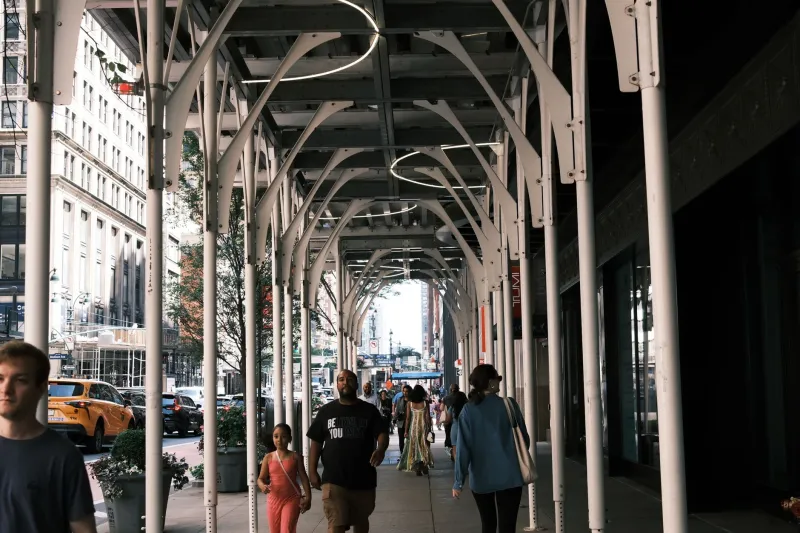
Spend a week in New York, then fly directly to Savannah, Georgia. Don't unpack. Just walk out the door and start moving.
Within about ninety seconds, something uncomfortable happens. Your legs are still doing New York math — calculating gaps, threading through foot traffic that isn't there, accelerating toward crosswalks that give you a full thirty seconds instead of eight. You're a drummer playing at the wrong tempo. The city around you is playing a ballad and your body is still mid-solo.
This isn't jet lag. It's something weirder and more interesting: the residue of urban rhythm, and the fact that cities are constantly, quietly, training your body to move in sync with them.
The Street Is a Metronome
Researchers who study pedestrian behavior — and yes, that's a real field — have documented for decades that walking pace isn't just a personal preference. It's deeply situational. A landmark 2007 study led by British psychologist Richard Wiseman found that average walking speeds in major cities had increased roughly 10 percent over the previous two decades, with the fastest walkers concentrated in dense, economically active urban cores.
But pace is only the most obvious layer. Cadence — the rhythmic pattern of your steps, the micro-adjustments you make to avoid collisions, the way you unconsciously draft behind faster walkers like a cyclist in a peloton — all of this gets calibrated by the city around you.
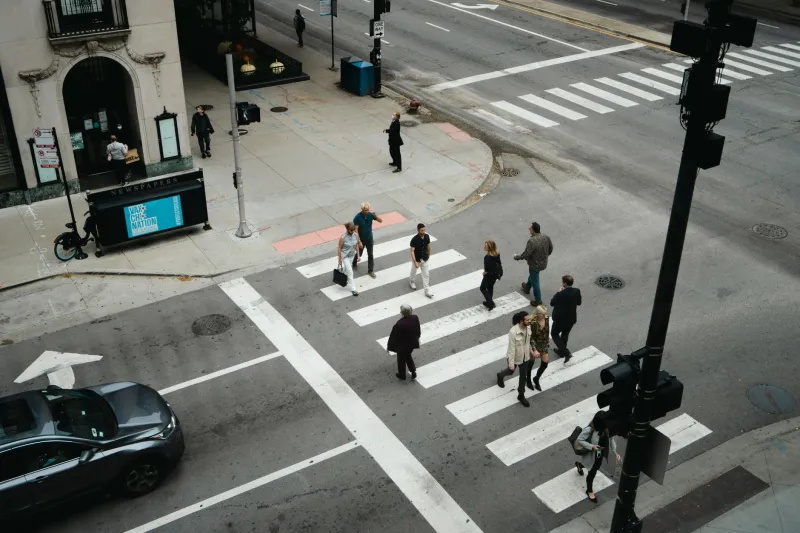
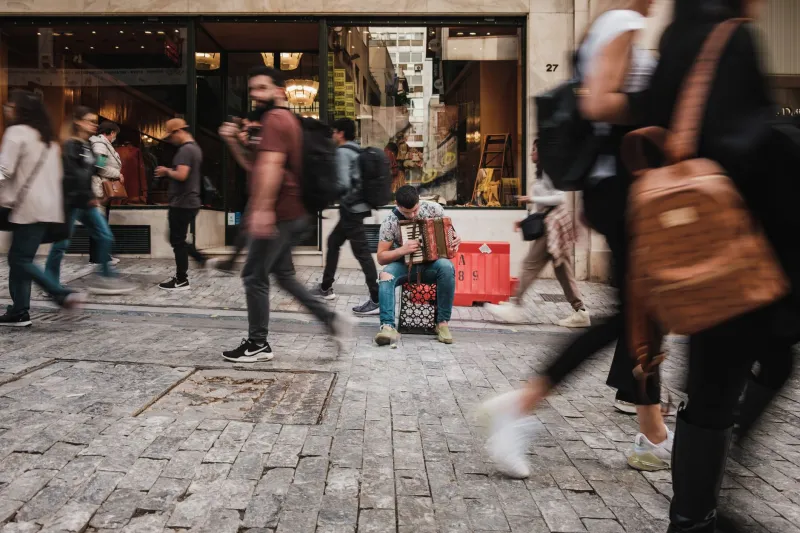
Think about what's actually happening on a busy urban sidewalk. Traffic signals dictate burst patterns: everyone waits, then everyone moves at once, creating a wave. Street musicians anchor corners with a beat that bleeds into your stride whether you register it or not. The width of a sidewalk determines how many people walk abreast, which shapes your speed options. Even the texture of the pavement — smooth concrete versus old cobblestone versus cracked asphalt — changes your step length and foot strike in ways your nervous system processes long before your brain does.
The city is a metronome. You're just the musician trying to keep up.
Why Some Cities Feel Like They're Rushing You
Not every city pulses at the same frequency, and the reasons are layered.
Block length matters enormously. Cities with short blocks — New York's classic 250-foot grid, for example — create constant decision points. Cross street, don't cross, pivot, recalculate. Short blocks keep walkers mentally and physically engaged, which naturally accelerates pace. Cities with longer, more suburban-style blocks do the opposite: fewer interruptions, less stimulation, slower movement.
Density of street-level activity plays a role too. A block lined with open storefronts, food carts, and human interaction pulls you forward with curiosity. A block of parking garages and blank facades has the opposite effect — it's hard to sustain momentum when there's nothing to move toward.
Then there's what urban planners sometimes call "pedestrian pressure" — the simple physics of how many bodies are sharing a given stretch of sidewalk. In high-density areas, you don't just choose your speed; it gets negotiated for you, collectively, in real time. You become part of a fluid system, and the system has its own logic.
The Musicians Who Figured This Out First
Street performers have understood urban rhythm intuitively for generations. Ask any seasoned busker and they'll tell you: the tempo you play in a subway station during rush hour is not the tempo you play on a Saturday afternoon in a park. You match the crowd, or the crowd walks past you.
Some performers go further, consciously using tempo to shape pedestrian behavior — slowing a song down to make people linger, speeding it up to match the energy of a busy intersection. It's a feedback loop. The city sets a tempo, the musician reads it, the music reinforces it, and the walkers lock in.
What's remarkable is how little of this is conscious. Most people couldn't tell you the BPM of the song playing as they walked by. But their stride rate? It adjusted anyway.
The Decompression Problem
Here's where it gets personally relevant for anyone who travels between cities on foot.
Your body learns a city's rhythm faster than your brain does, and it unlearns it slowly. Urban planners and behavioral researchers have a term for the mismatch that happens when a high-tempo urban walker suddenly finds themselves in a lower-density environment: locomotor adaptation lag. Informally, it's what happens when you're the person power-walking through a quiet neighborhood farmer's market while everyone else is ambling, and you can't figure out why you feel vaguely agitated.
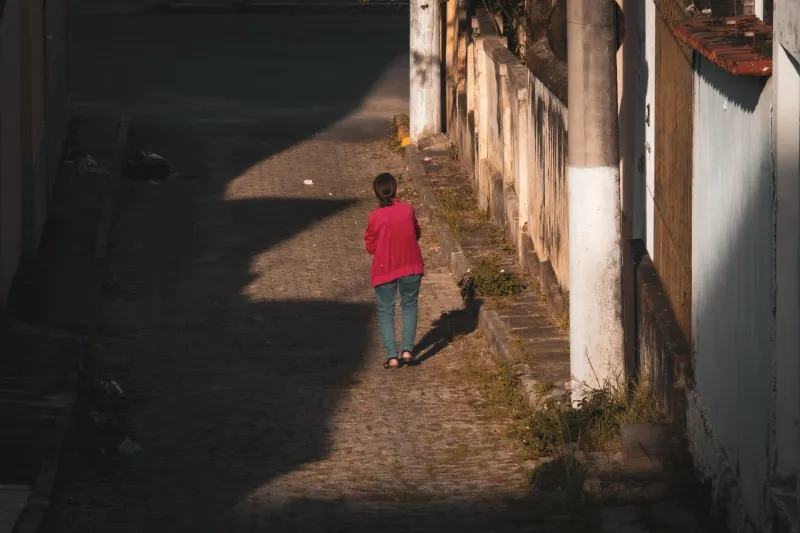
The reverse is equally disorienting. Arrive in Chicago or Philadelphia after a week in a small town and you'll spend your first hour getting bumped, cut off, and generally out-maneuvered by locals who've been calibrated to that sidewalk's specific frequency since childhood.
This is part of what makes walking the best way to actually feel a new city rather than just see it. The tempo mismatch is data. It tells you something real about how a place operates, what it values, and how it moves through time.
What Urban Designers Are Starting to Do With This
The more interesting urban design offices in the US are starting to think deliberately about rhythm — not just flow or capacity, but the actual experiential tempo of a street.
Activated ground floors that put retail, restaurants, and community spaces at eye level aren't just aesthetically pleasant; they create what designers sometimes call "perceptual density," a sense of constant low-level engagement that keeps walkers moving at a pace that feels purposeful without feeling rushed. Wider sidewalks with designated zones — moving lanes, standing zones, café seating — borrow directly from the logic of how crowds naturally self-organize.
Some cities are even rethinking signal timing not just for vehicle throughput, but for pedestrian rhythm. Longer walk signals in neighborhood commercial districts, shorter ones near transit hubs — small adjustments that quietly tune the tempo of an entire block.
It's urban choreography, and the dancers mostly have no idea they're performing.
Your Walk, Your Data
Next time you're in a new city, try something simple: don't fight the tempo. Let yourself get entrained by it. Notice how long it takes before your stride stops feeling effortful and starts feeling automatic. Pay attention to the moments when something — a busker, a slow tourist group, a suddenly empty block — breaks the rhythm and your body has to recalibrate.
You're not just walking through a city. You're being tuned by it, one block at a time.
That's the thing about exploring on foot that no map, no transit app, no car window can give you: the city gets into your body. It changes how you move. And if you're paying attention, that's one of the most honest things a place can tell you about itself.