Reading the Gaps: What Empty Storefronts Are Actually Telling You About a City's Future
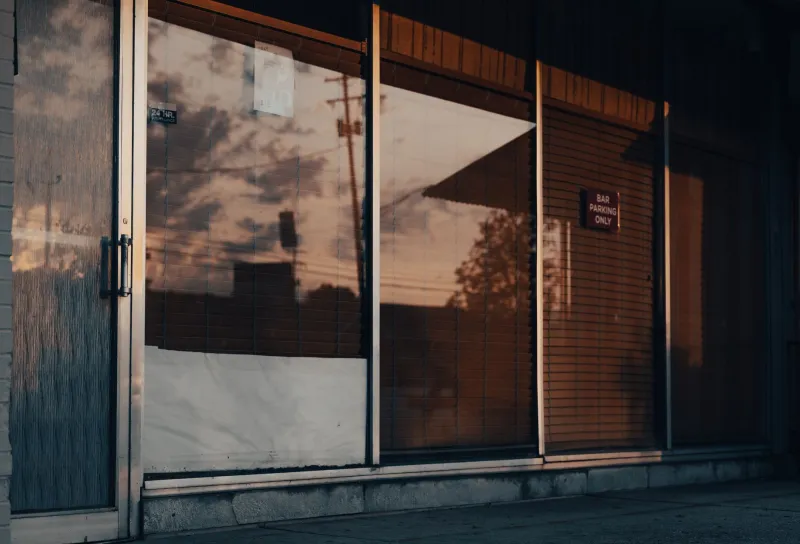
There's a particular kind of silence that lives behind a papered-over window. It's not the quiet of a closed shop or a business on vacation. It's something heavier — the absence of whatever used to hum there. Walk down enough commercial corridors in enough American cities and you start to feel it in your chest before your brain even registers what you're seeing.
Empty storefronts are everywhere right now. But here's the thing most people miss when they scroll past think-pieces about the retail apocalypse or the death of Main Street: the pattern of vacancy matters just as much as the vacancy itself. Where the gaps cluster, how long they've been sitting, what's sitting next door — all of it adds up to something close to a forecast. A city in motion, caught mid-sentence.
The Block Is a Document
Walkers who pay attention to this stuff — urban explorers, neighborhood researchers, the kind of people who photograph storefronts the way birders photograph warblers — will tell you that a single vacant unit doesn't mean much. Three in a row starts a conversation. Five or six in a two-block stretch is practically a press release.
In cities like Cleveland, Memphis, and Fresno, long stretches of empty retail in historically commercial corridors often signal something that's been happening underground for years: population shifts, disinvestment, the slow migration of foot traffic toward a new gravitational center. The storefronts are just the visible exhaust of those deeper forces.
But flip that script and look at a neighborhood like East Austin or Pittsburgh's Lawrenceville a few years back — or parts of Detroit's Corktown before the renovation wave hit — and you'll find a different kind of vacancy. Isolated empty units scattered among still-active businesses. Longer lease gaps. Fresh paint on the brick even though the space is dark inside. These aren't signs of decline. They're often the earliest readable signal that rents are climbing and longtime tenants are getting squeezed out before anything shinier moves in.
Same empty storefront. Completely different story.
How to Actually Walk This
If you want to use vacancy as a reading tool, you have to slow down more than you think. Most walkers move through commercial strips on autopilot, eyes up at signage or down at their phones. To read the gaps, you need to actually stop at them.
Look at the windows first. Papered from inside usually means recent closure — someone still cared enough to block the view. Dusty glass with old signage still faintly visible suggests longer-term vacancy. A cleaned-out shell with a fresh "For Lease" sign and a broker's number is a different animal entirely: that's a space being actively marketed, which tells you someone thinks there's demand.
Then look at the neighbors. An empty unit flanked by a nail salon that's been there fifteen years and a corner bodega with hand-lettered signs is in a different universe than an empty unit between a craft cocktail bar and a yoga studio. Context isn't everything — it's almost everything.
Finally, look down. The sidewalk in front of a long-vacant space often tells on itself. Cracked concrete, weeds in the seams, faded painted curbs — these are signs of neglect that accumulate over time. A recently emptied space usually still has a relatively intact sidewalk because the previous tenant was maintaining it.
The Geography of Anticipation
Some of the most interesting walking you can do in any American city right now involves tracing what researchers sometimes call "the vacancy frontier" — the leading edge where empty retail gives way to active commercial life, and what lies just behind it.
In Chicago's South and West sides, community members and urban planners have been mapping these corridors for years, trying to distinguish between vacancy that signals abandonment and vacancy that signals speculation. The difference matters enormously for policy, but it also matters for the people who live and walk there every day. A block that's being quietly assembled by a developer feels different from a block that's just slowly dying — even if, from the outside, both look like a row of dark windows.
In secondary cities — think Albuquerque, Tulsa, Akron — the pattern often tells a story about downtown revitalization cycles that have stalled or shifted direction. You'll find clusters of vacancy right at the edges of whatever the city's current "hot zone" is, places that were supposed to be next but somehow never got there. These in-between corridors are some of the most honest places in any city. Nobody's performing anything there. The economics are just sitting out in the open.
What the Gaps Don't Tell You
It's worth being honest about the limits of this kind of street-level reading. Vacancy patterns can be misleading. A landlord holding out for a specific tenant type — or waiting for a zoning change — can create the appearance of distress in a corridor that's actually quite healthy underneath. Cities with strong commercial rent control sometimes show higher surface vacancy because the incentives for landlords work differently.
And sometimes a string of empty storefronts is just a string of empty storefronts. Bad luck, bad timing, a anchor tenant that left and took foot traffic with it. Urban pattern-reading is more art than science, and anyone who tells you they can read a block like a balance sheet is overselling it.
But here's what is reliable: the act of walking these corridors, repeatedly, over time, builds a kind of intuition that no report can replicate. The city changes slowly and then all at once, and the storefronts are often the first place that change becomes legible — if you're moving slowly enough to read it.
Put Your Feet to Work
Next time you're walking a commercial strip in your city — or any city you're visiting — try treating the empty spaces as seriously as the occupied ones. Note what's gone dark recently. Note what's been dark so long the paint is peeling. Note what's sitting empty but freshly staged, waiting for someone with money and a vision.
Then come back in six months and walk it again.
The city will have written a new paragraph. The gaps will have shifted. Some will have filled in; others will have grown. And you'll have something no algorithm can generate: a felt sense of where a place is actually heading, one block at a time.