Before the Latte Arrives: How to Read a Neighborhood's Economic Future From the Sidewalk Up
By the time a neighborhood makes the local paper's real estate section, the story is already old. The coffee shop is already open. The rents are already up. The longtime residents are already gone or going. What the article never tells you is that the physical street announced all of this way earlier — in the texture of a freshly patched sidewalk, in the particular style of a security gate, in the weight of a door handle nobody asked you to notice.
At QWalk, we spend a lot of time on foot in American cities, and one of the most useful skills you can develop as an urban explorer is learning to read commercial gentrification the way a geologist reads rock strata — layer by layer, detail by detail, long before the seismic shift becomes obvious. Here's how to do it.
Start With the Gates
Before a block turns over, look at what's protecting the storefronts that are still holding on. Old-school roll-down security gates — the solid, corrugated steel kind that blot out the window entirely — are a signature of a neighborhood that hasn't yet attracted the attention of outside capital. They're functional, they're cheap, and they send a clear message: this is a place that locks down hard at night.
Now look for the newer, open-grid accordion gates. The ones you can see through. These started showing up in transitional commercial corridors about a decade ago, and their presence is almost always a leading indicator. A landlord who installs a see-through gate is making a subtle bet that the block will feel safe enough — and attractive enough — that visibility becomes an asset rather than a liability. When you start spotting those gates mixed in with the old solid ones, you're standing in the middle of a neighborhood that's actively negotiating its own identity.
The Sidewalk Is a Timeline
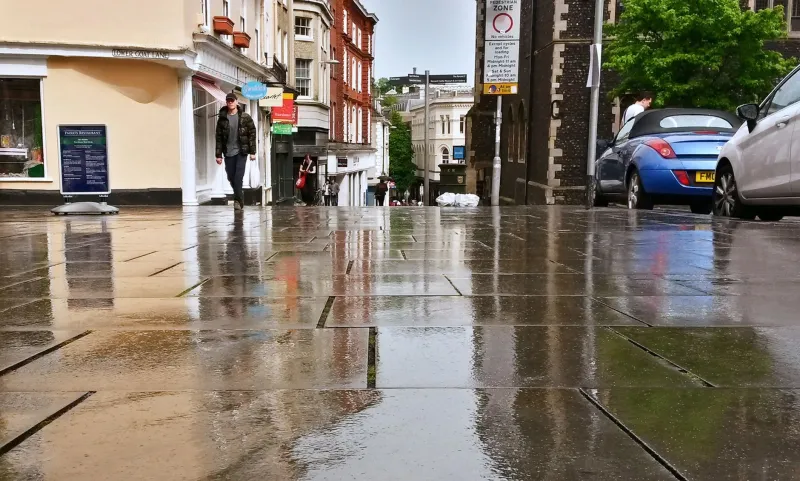
Pay attention to the concrete under your feet. Cities repair sidewalks in sections, and those repairs leave a physical record of investment patterns. A stretch of block where half the squares are original cracked concrete and the other half are smooth, uniform, recently poured slabs tells you exactly where a property owner — or a BID, a Business Improvement District — has started spending money.
Fresh curb cuts are another tell. When a city installs new ADA-compliant ramps at a corner that's been broken for years, it's not random. Infrastructure spending tends to follow anticipated commercial activity, not precede it. Someone, somewhere, already made a decision about this block.
Also look at the tree pits. Neglected, crumbling, filled with cigarette butts? That's a street that hasn't been prioritized. Freshly bordered with cast-iron guards, newly planted with a young ginkgo? That's a street someone is grooming.
Fixtures Tell You Who the Landlord Is Betting On
This one sounds almost too small to matter, but it isn't: look at the hardware on storefronts. Door handles, address numbers, light fixtures above the entrance. A landlord who replaces a plastic address placard with brushed brass numbers is not doing it for the current tenant. They're doing it for the next one — the one they're imagining when they picture what this block could be.
Same goes for exterior lighting. Cheap fluorescent tubes in a wire cage say one thing. A cluster of Edison-style pendant bulbs behind glass says something entirely different about who the landlord thinks is coming. You don't install that kind of lighting for a 99-cent store. You install it for a wine bar that hasn't signed a lease yet.
Sidewalk Cafe Placements as Economic Signals
Outdoor seating is one of the most visible, most legible signs that a commercial corridor is being reimagined for foot traffic rather than car traffic. But the details matter more than the mere presence of a few chairs.
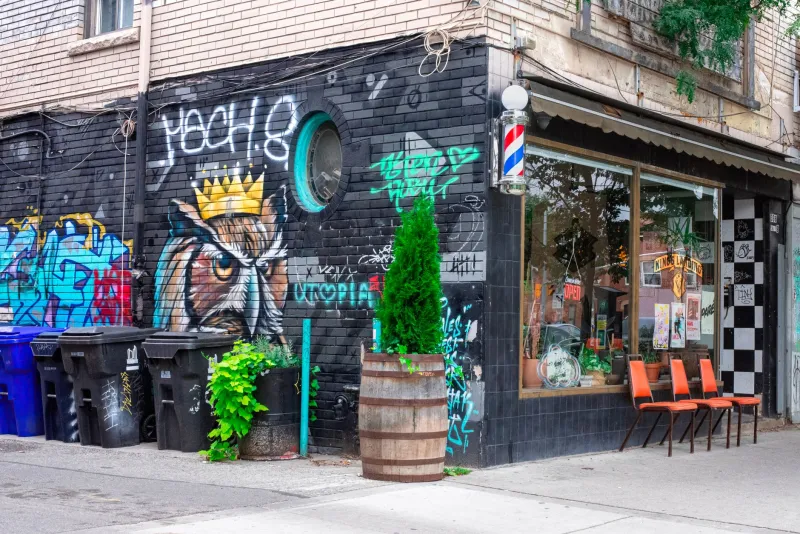
Look at the quality of the furniture. Plastic stacking chairs from a restaurant supply warehouse are a different signal than powder-coated steel bistro sets. Look at whether the cafe is enclosed by a barrier — a planter, a low fence, a rope — or just spills openly onto the sidewalk. Barriers signal permanence, investment, and an expectation that the space will be used consistently. Open spillover seating is more tentative.
Also notice where on the block the outdoor seating is appearing. Early-stage gentrification tends to cluster at corner locations and near transit stops — the highest-visibility, highest-foot-traffic spots. As it deepens, it fills in toward the middle of the block. If you're seeing chairs and tables at mid-block spots, you're probably a few years behind the curve.
What the Vacant Storefronts Are Actually Saying
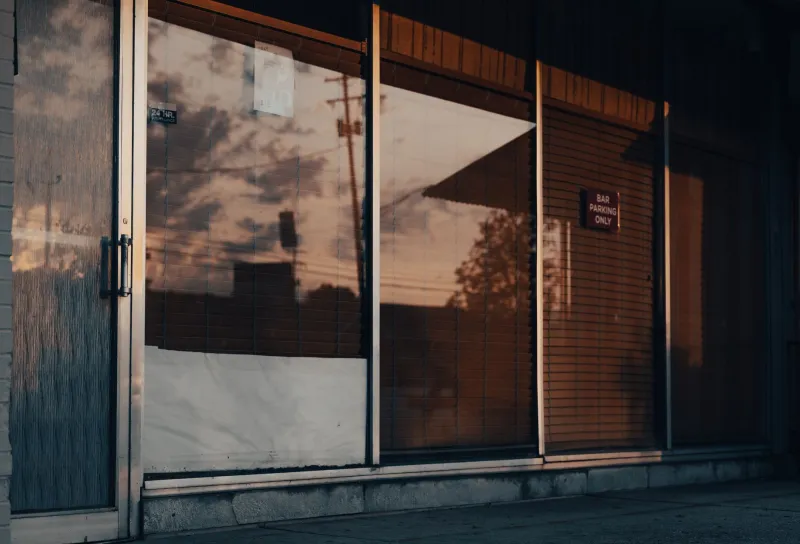
Empty storefronts get misread constantly. People assume vacancy means decline, but in a transitional neighborhood, a specific kind of vacancy is actually a sign of incoming investment. Look at the windows.
Papered-over windows with no signage at all? Often a sign of genuine distress — a landlord waiting, a lease dispute, a business that left quietly. But whitewashed windows with a small, tasteful "coming soon" card? That's a landlord who can afford to wait for the right tenant at the right price. The whitewash itself is a message: this space is not desperate.
Also pay attention to how the empty space is being maintained. Is there a fresh coat of paint on the facade? Has the landlord bothered to pressure-wash the sidewalk out front? Maintained vacancy is a holding pattern. Neglected vacancy is something else.
The Mural Paradox
Street art and murals are complicated signals. A commissioned mural — especially one that's been coordinated with a local BID or a developer — is almost always a beautification play, meaning someone with money is trying to make the block more visually appealing to incoming businesses and residents. It's not organic. It's a stage set.
Contrast that with older, grittier, permission-or-not murals that have been there for years. Those are cultural markers of a neighborhood's existing identity. When you start seeing the commissioned stuff appearing alongside the old organic stuff, you're watching two eras of a place exist simultaneously — and that overlap tends to be brief.
Walk It More Than Once
The real skill in reading these signals isn't noticing any single detail — it's building a picture over time. Walk the same block in the morning and at night. Walk it on a Tuesday and a Saturday. Walk it in winter and again in spring. The street reveals different layers depending on when you show up.
That's the whole point of urban exploration done right. You're not just passing through; you're accumulating evidence. The sidewalk doesn't lie, but it does require patience. Every block is telling you a story — you just have to learn to read it before the real estate section does.