Two Blocks From Everything: The Middle-Distance Walk That Actually Shows You a City
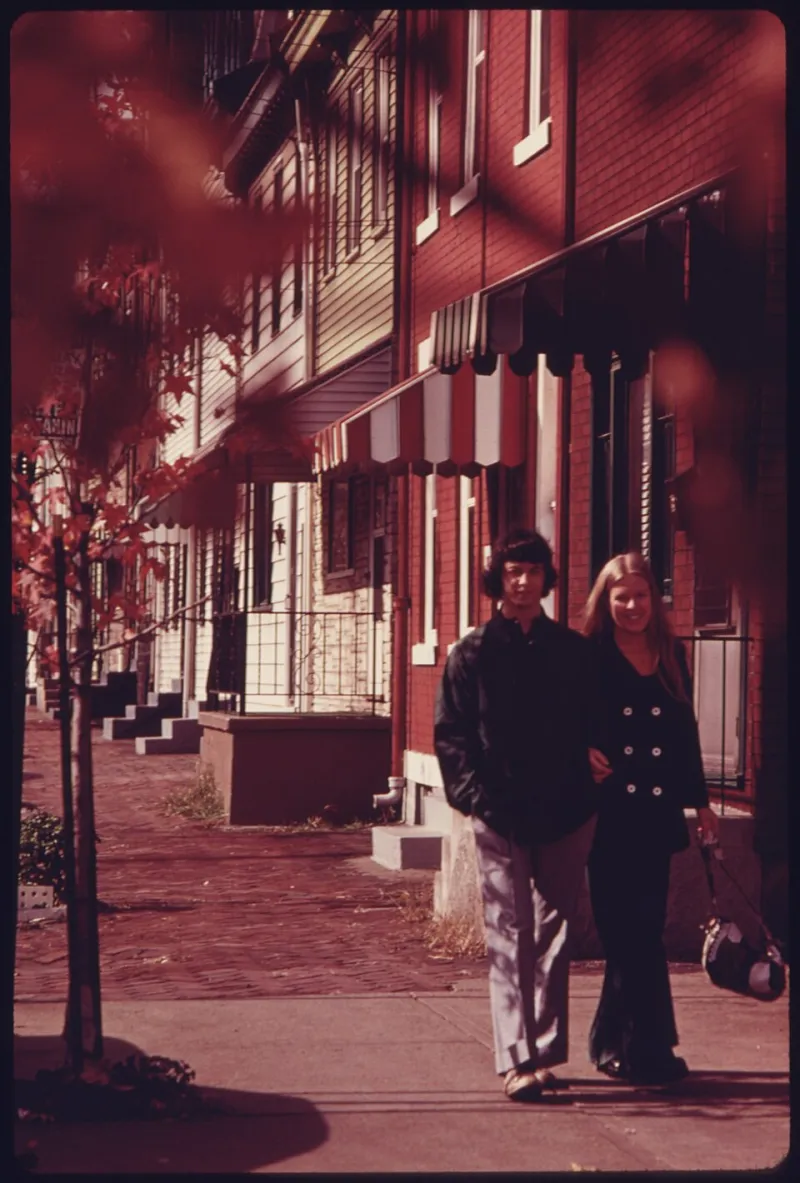
Photo: John L. Alexandrowicz, Public domain, via Wikimedia Commons
There's a particular kind of walk that almost nobody talks about. It's not the quick dash across the street to grab a coffee. It's not the dedicated three-mile urban hike with a podcast in your ears and a destination in mind. It's something in between — the two, three, maybe four-block stretch that connects one thing to another without being a journey in its own right.
We'd call it the forgotten mile, except it isn't even a mile. It's just... the middle distance. And if you start paying attention to it, you might never look at a city the same way again.
The Gap Between the Landmark and the Block Party
Tour guides love extremes. They'll walk you to the famous mural, the historic church, the converted warehouse that's now a food hall. Urban explorers go the other direction — they're hunting the hidden, the obscure, the alley that only locals know about. Both are valid. Both are fun.
But here's what both camps tend to miss: the unremarkable connective tissue between those moments. The stretch of Penn Avenue in Pittsburgh where a 1920s brick commercial building sits shoulder-to-shoulder with a vinyl-sided rowhouse and a vacant lot that someone has quietly turned into a community garden. Nobody put that on a map. Nobody wrote a blog post about it. But walk it slowly and you're reading about a hundred years of economic fortune and misfortune written in facades.
That's what the middle-distance walk does. It forces you to notice transition — architectural, demographic, economic — because you're covering just enough ground to see change without moving so fast that it blurs.
Pittsburgh's Lawrenceville Lesson
Lawrenceville in Pittsburgh is a neighborhood that gets plenty of attention these days. Magazines have called it one of the coolest neighborhoods in America, and the stretch of Butler Street that anchors it is genuinely lively. But walk two blocks off Butler in almost any direction and things shift immediately.
Head east toward the river on a side street and within three blocks you've moved from craft cocktail bars to working-class front porches to a stretch of light industrial buildings that still smell faintly of steel. The sidewalk changes width. The trees disappear. A hand-painted sign on a garage door advertises auto body work with a phone number that looks like it hasn't been updated since the nineties.
That's not a failure of the neighborhood. That's the neighborhood. The two-block walk off the main drag gave you something the main drag never could: context.
Memphis and the Art of the Informal Gathering Spot
In Memphis, try this sometime. Park yourself at the corner of Cooper and Young in Midtown and then walk three blocks in any direction. You'll hit a different social world on each axis. North takes you toward quieter residential blocks where front-porch culture is still alive and well. East nudges you into a stretch where the sidewalk is technically there but barely maintained, forcing pedestrians into a slow, watchful shuffle. West drops you into a commercial zone where a barbershop, a nail salon, and a Pentecostal church occupy three consecutive storefronts.
None of these things are on a tourist map. But each one of those three-block walks reveals something essential about how Memphis organizes its social life — not around grand civic spaces, but around informal nodes. The barbershop that's been there for thirty years. The corner where someone always seems to be standing, talking, watching the street.
Social geographers have a term for these spots: third places. Not home, not work, but the informal gathering points that hold communities together. The middle-distance walk is almost uniquely positioned to find them, because they're rarely at the landmark and they're rarely hidden. They're just two blocks away.
The Architecture of In-Between
One of the most underrated pleasures of the mid-length walk is what happens to architecture in the spaces between the showpieces. American cities are full of what you might call transitional blocks — stretches where the building stock represents three or four different eras layered on top of each other with no particular logic.
In smaller metros, this is especially pronounced. Walk three blocks through downtown Akron, Ohio, or Shreveport, Louisiana, or Spokane, Washington, and you'll encounter a kind of accidental architectural museum. A Beaux-Arts bank building from 1908, converted to apartments. Next door, a mid-century modern commercial strip that replaced something older. Then a surface parking lot — the ghost of a building that didn't survive. Then a new mixed-use development trying to stitch it all back together.
None of those buildings are famous. But together, on a single block face, they tell a story about how American cities boom, bust, adapt, and try again. You need the middle distance to read that story. One block isn't enough. A full walking tour moves too fast.
How to Actually Do This
The practice is simple, which is part of why it gets overlooked. Next time you're in a city — any city, your own included — pick a spot you know reasonably well. Then walk two blocks in a direction you don't usually go. Not toward something. Just two blocks.
Look at what's on the ground floor of every building. Notice where the sidewalk is wide and where it narrows. See if there are benches, and whether anyone is using them. Check if there's a bus stop, and whether it has a shelter. Look up at the second and third floors of buildings — that's often where the older character of a block survives, unchanged, while the street level has been renovated beyond recognition.
You're not looking for anything in particular. You're just reading. The city is always talking. The middle-distance walk is one of the best ways to finally listen.
The Smallest Scale, the Biggest Truths
There's a reason QWalk exists: cities reveal themselves to people who move through them slowly and with attention. The grand walking tour has its place. The hidden-gem hunt is genuinely fun. But don't underestimate the modest, purposeless, two-to-four block wander that connects one thing to another.
That's where the authentic texture lives. That's where you find the garden in the vacant lot, the barbershop that's been there forever, the building that survived everything the twentieth century threw at it. That's where a city stops performing for visitors and just... exists.
Two blocks from the landmark. Two blocks from the hidden gem. Right there in the middle, the city is telling you who it actually is.